Periodic stimuli (waves, gratings, grids,…)#
Tip
This guide explains the principles behind, behavior of, and relations between
the parameters of periodic stimuli in stimupy.
For a more hands-on demonstration of how those parameters affect a specific stimulus,
see, e.g., Stimuli - Waves
Many commonly used visual stimuli are some sort of periodic stimulus:
sinewaves gratings are the most obvious example,
but also checkerboards, grids, sets of rings, and pinwheels can be considered periodic.
stimupy includes many of these as stimuli and constructs them as periodic,
which has some particular advantages.
The simplest variants can be found in stimupy.stimuli.waves
from stimupy.stimuli import waves

from stimupy.utils import plot_stimuli
Interdependence of parameters#
Periodic stimuli (e.g., waves)
consist of repetitions of some elements or phases.
In a sinewave grating, these are the light and dark phases.
in a squarewave grating, those same phases visually appears as white and black bars:
sinewave = waves.sine_linear(visual_size=(10, 10), ppd=10, n_bars=5)
squarewave = waves.square_linear(visual_size=(10, 10), ppd=10, n_bars=5)

plot_stimuli({'Sine': sinewave, 'Square': squarewave})
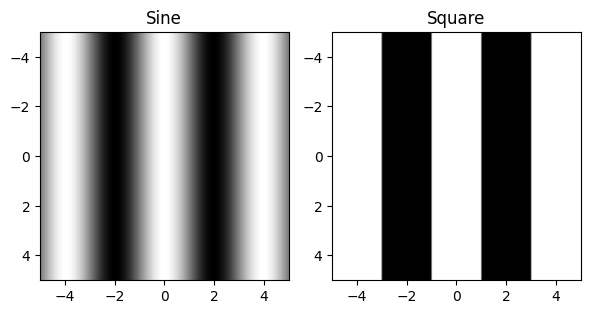
There is regularity to periodic stimuli (what makes the periodic), namely that there are repeated cycles (here of 2 phases/elements per cycle), where each cycle is identical to each other cycle. This regularity can be expressed in several different ways, with several different parameters – and these parameters have some interdependence on each other.
Tip
In the examples in this section,
the code for the sinewave will remain the same across examples,
the code for the squarewave will demonstrate the different parameterization
(keeping the output images the same)
Frequency \(\sim\) number of elements#
The number of elements can also be expressed a spatial frequency: here we have \(5\) bars, which corresponds to \(5/2 = 2.5\) cycles of light-dark. \(2.5\) cycles, in \(10\) degrees of visual angle, is \(2.5/10 = .25\) cycles per degree of visual angle (cpd).
In some cases, you may want to conceptualize your stimulus in terms of this frequency,
in other cases you may want to conceptualize your stimulus in terms of the n_bars.
stimupy allows you to do either:
sinewave = waves.sine_linear(visual_size=(10, 10), ppd=10, n_bars=5)
squarewave = waves.square_linear(visual_size=(10, 10), ppd=10, frequency=.25)

plot_stimuli({'Sine': sinewave, 'Square': squarewave})
Phase width vs. visual size#
To specify a periodic stimulus like these waves, a third parameter at play is
the phase_width, i.e., the size of each element (in this case: bar_width).
So far, we have specified the overall visual_size of the stimulus (e.g., (10, 10)).
To draw n_bars=5 (\(=\) frequency=.25) in \(10\) degrees,
each bar (/ phase) has bar_width of \(2\) degrees of visual of angle.
Sometimes, you may care more about specifying this size of each element,
rather than the total visual size of the stimulus (which is then resolved automatically)
stimupy allows you to do either:
sinewave = waves.sine_linear(visual_size=(10, 10), ppd=10, n_bars=5)
squarewave = waves.square_linear(visual_size=None, ppd=10, n_bars=5, bar_width=2)

plot_stimuli({'Sine': sinewave, 'Square': squarewave})
Phase width vs. number of elements / frequency#
Since only a certain number of elements with given width can be drawn
in a given total size,
this means that if we specify both visual_size and bar_width,
the number of bars is also determined:
sinewave = waves.sine_linear(visual_size=(10, 10), ppd=10, n_bars=5)
squarewave = waves.square_linear(visual_size=(10, 10), ppd=10, bar_width=2)

plot_stimuli({'Sine': sinewave, 'Square': squarewave})
Periodicity & resolution#
In general, to specify these periodic signals in a way that can be drawn, there are \(7\) relevant/possible parameters:
resolution parameters
visual_size,ppd,shapeperiodicity parameters
visual_size,frequency,bar_width,n_bars
The relations are such that:
\(2\) out of \(3\) resolution parameters are required to resolve
frequency(in cpd) andbar_width(in degrees per phase) are perfectly related:frequency = 1/(bar_width*2)\(2\) out of \(4\) periodicity parameters are required to resolve
Since visual_size is both a resolution and a periodicity parameter,
it can be resolved from one set and used for the other.
Thus, a specification of, e.g. ppd, n_bars and bar_width is enough:
sinewave = waves.sine_linear(visual_size=(10, 10), ppd=10, n_bars=5)
squarewave = waves.square_linear(ppd=10, n_bars=5, bar_width=2)

plot_stimuli({'Sine': sinewave, 'Square': squarewave})
Even, odd or integer number of elements#
Particularly for gratings, the requirements on the number of elements can be very different depending on the use-case.
In some cases, you may want to ensure that your grating has an integer number of phases,
e.g., if you want to avoid partial bars in a squarewave grating.
For other stimuli, you may be fine with an “incomplete” phase at the end, e.g. if your sinewave grating consists of 7.1 cycles.
In yet other situations, you may want to be even more specific and may want to make sure that you have an even number of phases in your grating,
(i.e. a full number of periods, as many bright as dark bars),
or an odd number of phases.
The period argument controls this behavior
when stimupy resolves the periodicity for you.
it can be "even", "odd", "either" (ensures only complete phases), or "ignore":
sinewave = waves.sine_linear(visual_size=(10, 10), ppd=10, n_bars=5)

# Resolve to "odd" number of phases
squarewave = waves.square_linear(visual_size=(10, 10), ppd=10, bar_width=2.5, period="odd")

plot_stimuli({'Sine': sinewave, 'Square': squarewave})
/home/docs/checkouts/readthedocs.org/user_builds/stimupy/envs/stable/lib/python3.11/site-packages/stimupy/components/waves.py:170: UserWarning: Adjusted phase_width=2.5 -> 2.0 because of period=odd
  warnings.warn(
Poor resolution, bad sampling#
Not all n_phases/frequencys are (equally) possible in a given image shape.
Specifically not all phase_widths are possible for a given ppd.
if there \(10\) pixels per degree of visual angle,
that each pixel increase means an increase of \(1/10\) degrees of visual angle.
Thus, at \(ppd=5\), the width of a, e.g., a bar can only change in \(1/10\) degree intervals
– meaning the phase_width can be \(2, 2.1, 2.2\) degrees, but not \(2.12\) degrees.
If desired (i.e. if round_phase_width=True), stimupy supports the user in cases where the given parameter values
result in a poor periodicity \(\times\) resolution combination.
Specifically, it will adjust/round the periodicity parameters to try and accomplish
the closest possible version of the stimulus, and warn you about this change.
Which way it rounds to, can be determined by the period argument:
sinewave = waves.sine_linear(visual_size=(10, 10), ppd=10, n_bars=5)

# Poor resolution:
squarewave = waves.square_linear(visual_size=(10, 10), ppd=10, bar_width=2.12, period="either")

plot_stimuli({'Sine': sinewave, 'Square': squarewave})
/home/docs/checkouts/readthedocs.org/user_builds/stimupy/envs/stable/lib/python3.11/site-packages/stimupy/components/waves.py:170: UserWarning: Adjusted phase_width=2.12 -> 2.0 because of period=either
  warnings.warn(
In fact, it will adjust whichever parameter was/were passed in:
sinewave = waves.sine_linear(visual_size=(10, 10), ppd=10, n_bars=5)

# Poor frequency:
squarewave = waves.square_linear(visual_size=(10, 10), ppd=10, frequency=.26, period="either")

plot_stimuli({'Sine': sinewave, 'Square': squarewave})
/home/docs/checkouts/readthedocs.org/user_builds/stimupy/envs/stable/lib/python3.11/site-packages/stimupy/components/waves.py:176: UserWarning: Adjusted frequency=0.26 -> 0.25 because of period=either
  warnings.warn(
Periodic in other orientations, distance metrics#
So far, you have seen linear periodic stimuli, specifically horizontal gratings.
We can rotate these, using the rotation parameter:
horizontal = waves.square_linear(visual_size=(10, 10), ppd=20, n_bars=10)
vertical = waves.square_linear(visual_size=(10, 10), ppd=20, n_bars=10, rotation=90)
oblique1 = waves.square_linear(visual_size=(10, 10), ppd=20, n_bars=10, rotation=45)
oblique2 = waves.square_linear(visual_size=(10, 10), ppd=20, n_bars=10, rotation=60)


plot_stimuli({'Horizontal': horizontal,
              'Vertical': vertical,
              '45 deg': oblique1,
              '60 deg': oblique2,
              })
/home/docs/checkouts/readthedocs.org/user_builds/stimupy/envs/stable/lib/python3.11/site-packages/stimupy/components/waves.py:348: UserWarning: Rounding phase width is turned off for oblique gratings
  warnings.warn("Rounding phase width is turned off for oblique gratings")
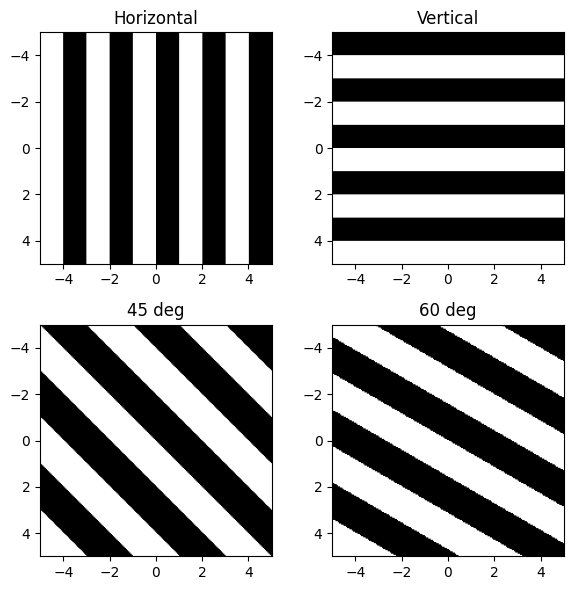
As stimupy warns: the rounding of phase_width to fit nicely in ppd
is not possible for oblique gratings.
This has to do with the ppd being defined horizontal/vertical,
while the grating is defined obliquely,
and thus cannot fall neatly in pixels anyway.
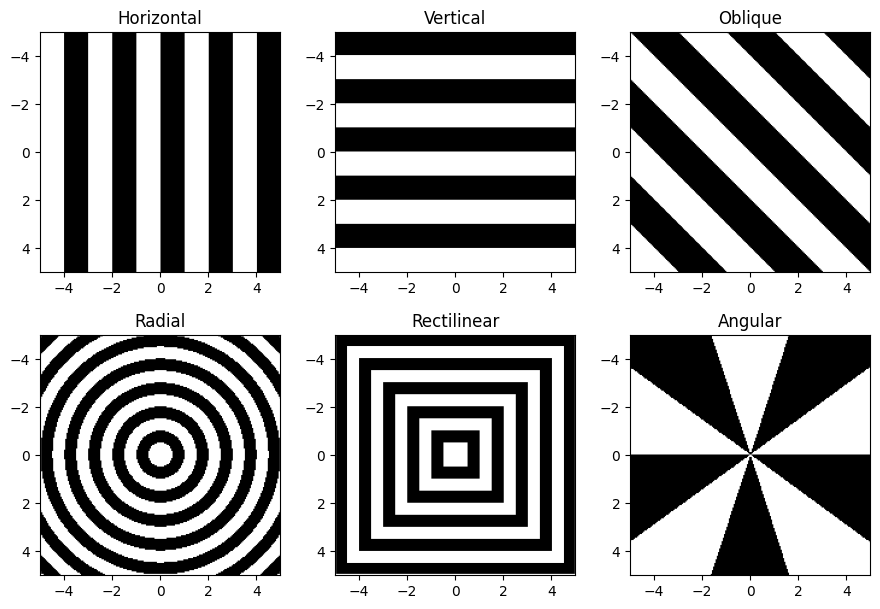
Other periodic stimuli (stimupy.stimuli.waves)
are analogous in the parameterization,
but are evaluated over different distance_metrics.
Additionally, the naming schema of the arguments is adjusted
to better fit the geometry of the distance metric.
Particularly the name for each phase is different:
for
linearwaves:barfor
radialwaves:ringfor
rectilinearwaves:framefor
angularwaves:segment
horizontal = waves.square_linear(visual_size=(10, 10), ppd=20, n_bars=10)
vertical = waves.square_linear(visual_size=(10, 10), ppd=20, n_bars=10, rotation=90)
oblique = waves.square_linear(visual_size=(10, 10), ppd=20, n_bars=10, rotation=45)
radial = waves.square_radial(visual_size=(10, 10), ppd=20, n_rings=10)
rectilinear = waves.square_rectilinear(visual_size=(10, 10), ppd=20, n_frames=10)
angular = waves.square_angular(visual_size=(10, 10), ppd=20, n_segments=10)

plot_stimuli({'Horizontal': horizontal,
              'Vertical': vertical,
              'Oblique': oblique,
              'Radial': radial,
              'Rectilinear': rectilinear,
              'Angular': angular})
Warning
The angular stimuli have a unique property
that the distance over which periodicity generated,
is fixed at \([0, 360]\) angular degrees.
As a result, the frequency argument for these stimuli
is interpreted as cycles per image (rather than cpd).
Thus, it is exactly n_segments/2, always.
Derived stimuli#
These parameters for periodic stimuli are also
part of the specification of stimuli that use or are derived from these.
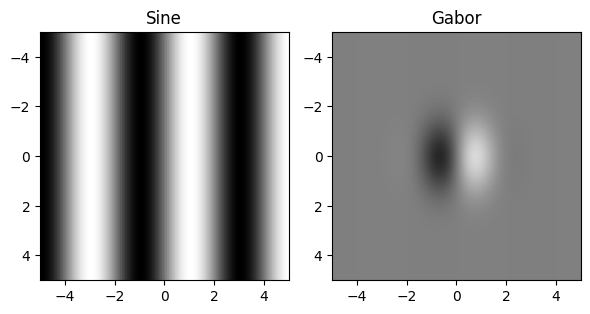
Gabors are a straightforward example:
it uses all the same waves.sine parameters:
from stimupy.stimuli import gabors

sinewave = waves.sine_linear(visual_size=(10, 10), ppd=10,
                             n_bars=5,
                             intensities=(0.0, 1.0),
                             origin='center')

gabor = gabors.gabor(visual_size=(10, 10), ppd=10,
                     n_bars=5,
                     intensities=(0.0, 1.0),
                     origin='center',

                     sigma=1)

plot_stimuli({'Sine': sinewave, 'Gabor': gabor})
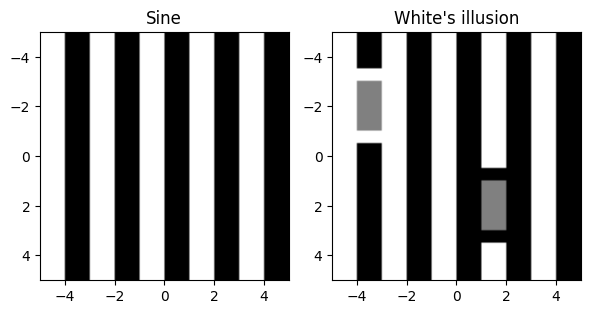
White's illusions are another example:
a squarewave grating, with several target-regions embedded in them.
There are lots of variations on this stimulus,
– some of which are implemented in stimupy –
but fundamentally all build on some squarewave grating
which takes the usual waves-params.
from stimupy.stimuli import whites

sinewave = waves.square_linear(visual_size=(10, 10), ppd=10,
                             n_bars=10,
                             origin="corner",
                             intensity_bars=(0.0, 1.0))

whites = whites.yazdanbakhsh(visual_size=(10, 10), ppd=10,
                             n_bars=10,
                             intensity_bars=(0.0, 1.0),

                             target_indices_top=2,
                             target_indices_bottom=-3,
                             target_heights=2,
                             target_center_offset=2,
                             gap_size=.5)

plot_stimuli({'Sine': sinewave, "White's illusion": whites})