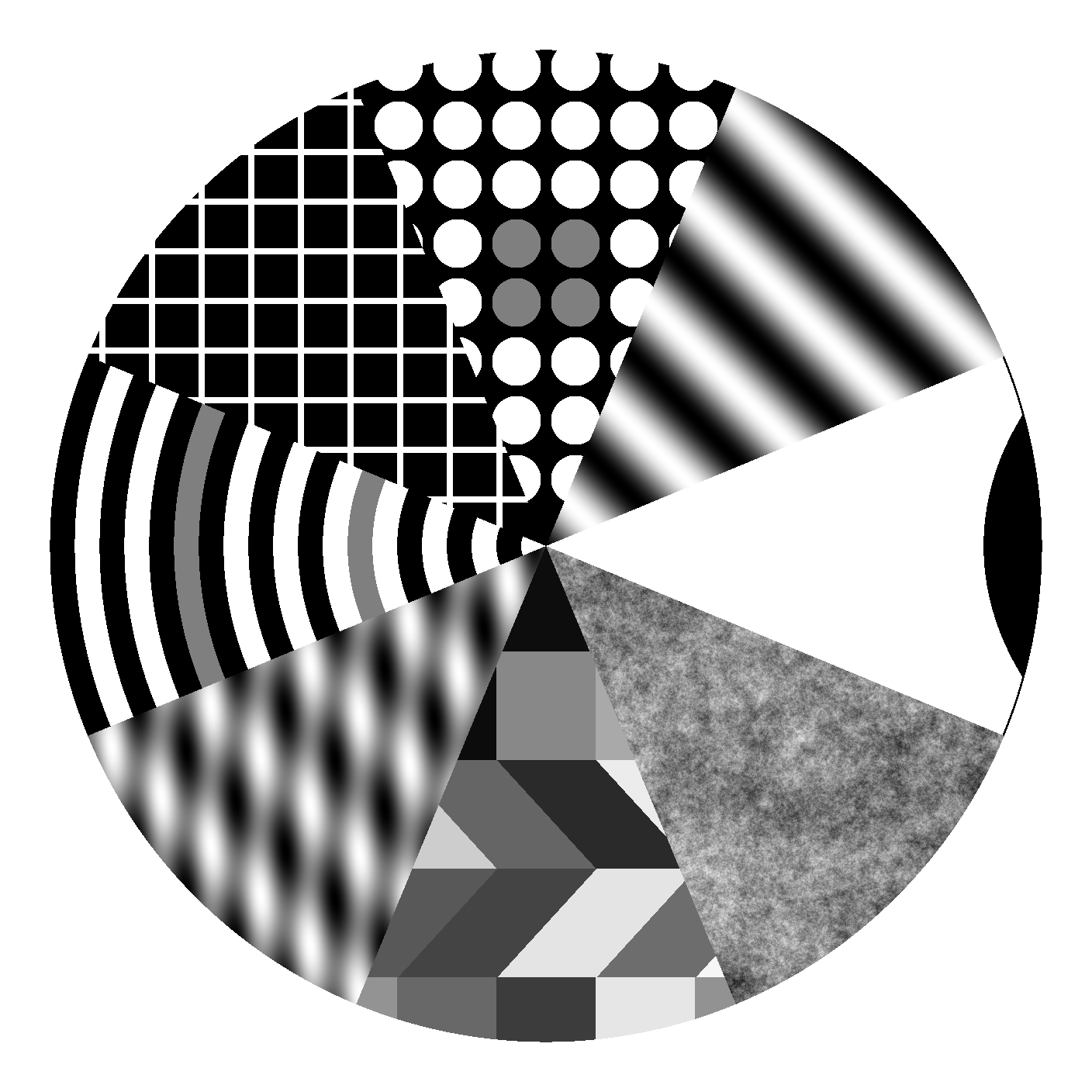
stimupy#
A pure-Python package for creating new and existing visual stimuli commonly used in the study of contrast, brightness, lightness, and other aspects of visual perception.
generate (novel) visual stimuli in a reproducible, flexible, and easy way
recreate exact stimuli as they have been used in prior vision research
explore large parameter spaces to reveal relations between formerly unconnected stimuli
provide classic stimulus sets (e.g. ModelFest), exactly as described in the original manuscripts (including experimental data)
build new stimulus sets or benchmarks (e.g. for testing computational models), and easily add them to
stimupysupport vision science by providing a large, openly-available and flexible battery of relevant stimulus functions
unify and automate stimulus creation
be FAIR: Findable, Accessible, Interoperable, and Reusable
🏃
Install stimupy
and follow an introductory tutorial
🧑🏫
Learn more about design decisions
and particular conventions and topics within stimupy
📑
Look up functions and their specific parameters, including through interactive demos
📨, 🎁
Ask a question, report a bug, request a feature, or contribute.
If you use stimupy for your scientific work, please cite the paper as:
Schmittwilken, L., Maertens, M., & Vincent, J. (2023). stimupy: A Python package for creating stimuli in vision science. Journal of Open Source Software, 8(86), 5321. https://doi.org/10.21105/joss.05321
Here is a BibTeX entry for this reference:
@article{Schmittwilken2023,
    doi = {10.21105/joss.05321},
    url = {https://doi.org/10.21105/joss.05321},
    year = {2023},
    publisher = {The Open Journal},
    volume = {8},
    number = {86},
    pages = {5321},
    author = {Lynn Schmittwilken and Marianne Maertens and Joris Vincent},
    title = {stimupy: A Python package for creating stimuli in vision science},
    journal = {Journal of Open Source Software}