dotted#
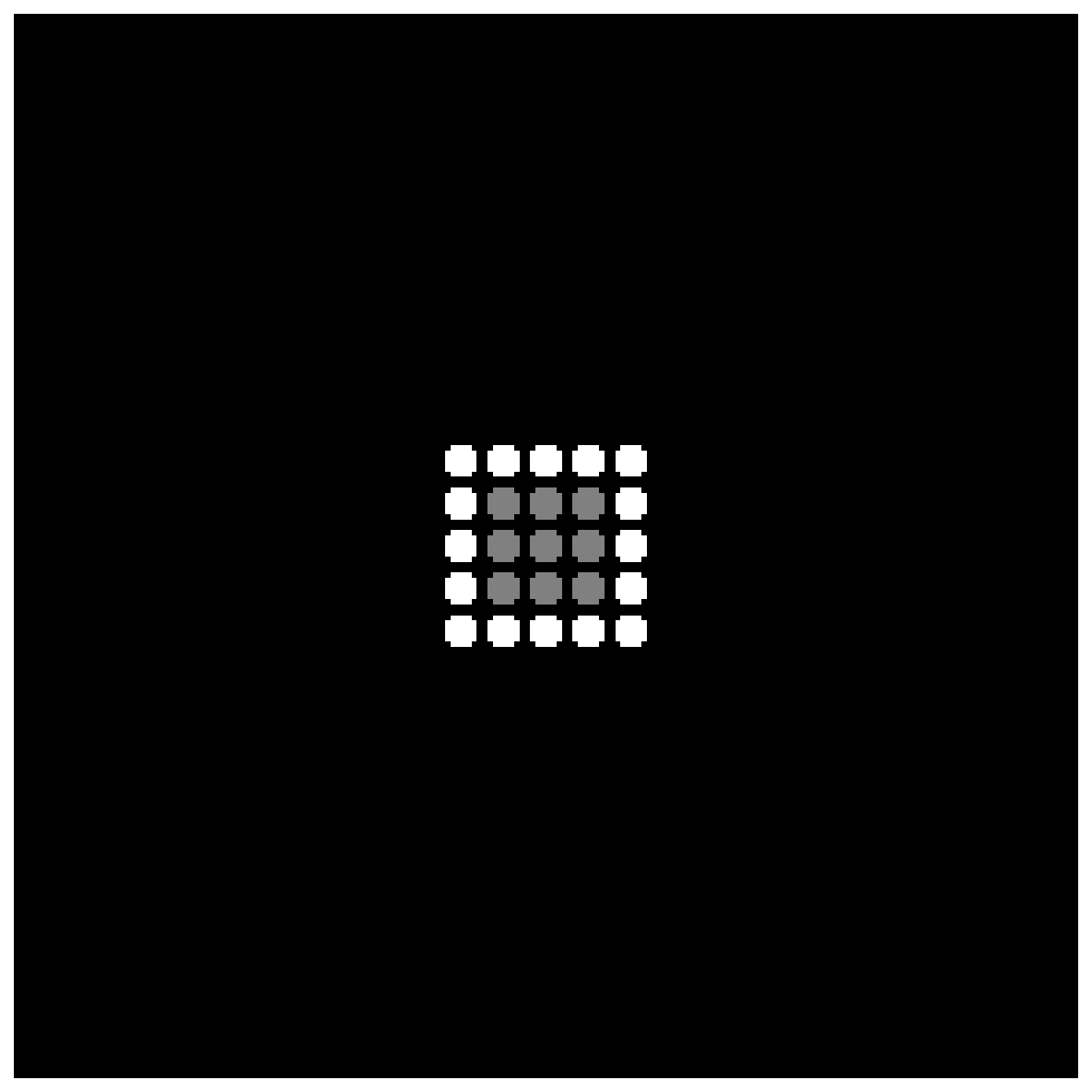
You can find an interactive version of this example here
- stimupy.stimuli.sbcs.dotted(visual_size=None, ppd=None, shape=None, n_dots=None, dot_radius=None, distance=None, target_shape=None, intensity_background=0.0, intensity_dots=1.0, intensity_target=0.5)#
Dotted simultaneous contrast
- Parameters:
visual_size (Sequence[Number, Number], Number, or None (default)) – visual size [height, width] of grating, in degrees
ppd (Sequence[Number, Number], Number, or None (default)) – pixels per degree [vertical, horizontal]
shape (Sequence[Number, Number], Number, or None (default)) – shape [height, width] of grating, in pixels
n_dots (int or (int, int)) – stimulus size defined as the number of dots in y and x-directions
dot_radius (float) – radius of dots
distance (float) – distance between dots in degree visual angle
target_shape (int or (int, int)) – target shape defined as the number of dots that fit into the target
intensity_background (float) – intensity value for background
intensity_dots (float) – intensity value for dots
intensity_target (float) – intensity value for target
- Returns:
dict with the stimulus (key: “img”), mask with integer index for the targets (key: “target_mask”), and additional keys containing stimulus parameters
- Return type:
References
- Bressan, P., & Kramer, P. (2008).
Gating of remote effects on lightness. Journal of Vision, 8(2), 16-16. https://doi.org/10.1167/8.2.16