circular#
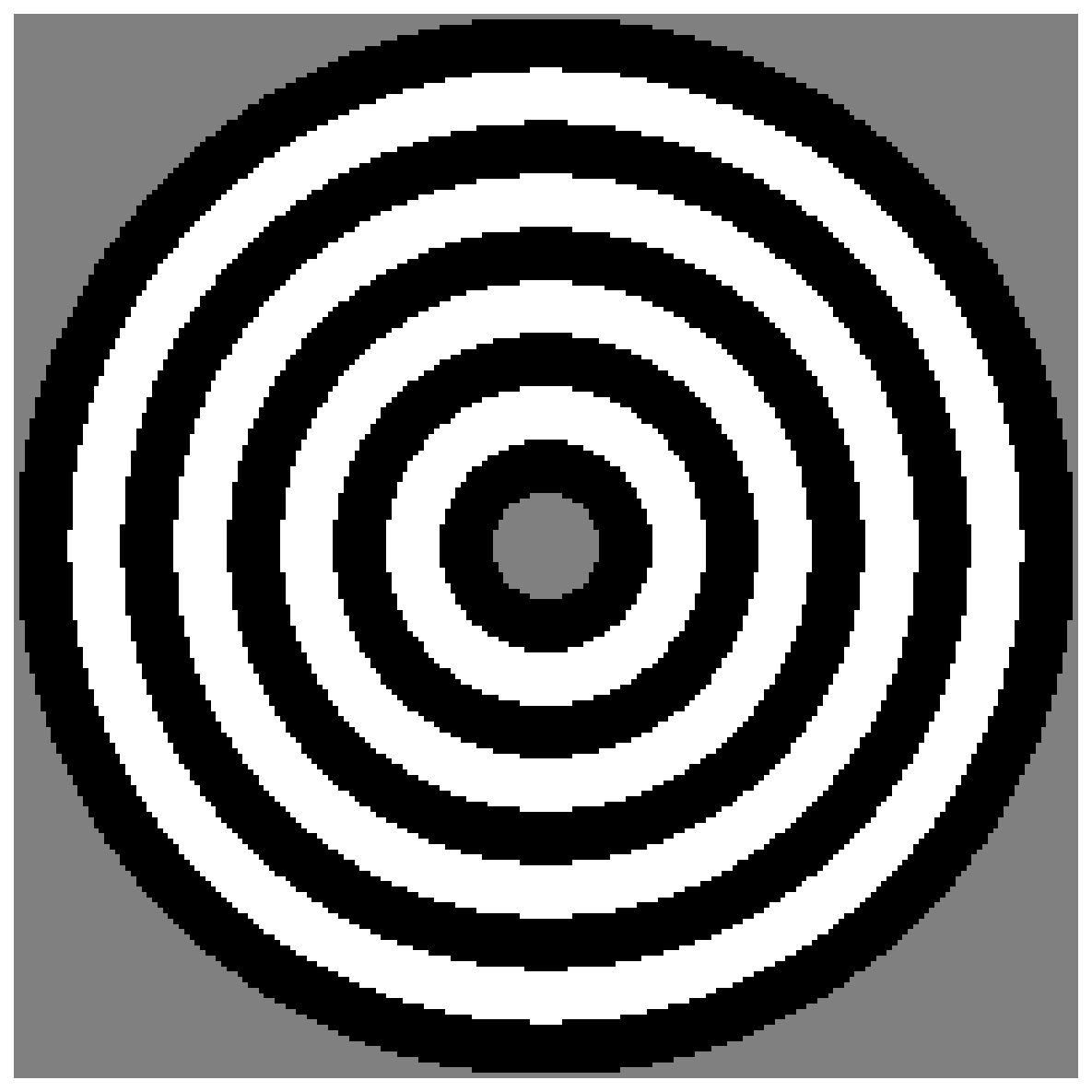
You can find an interactive version of this example here
- stimupy.stimuli.bullseyes.circular(visual_size=None, ppd=None, shape=None, frequency=None, n_rings=None, ring_width=None, phase_shift=0, intensity_target=0.5, intensity_rings=(0.0, 1.0), intensity_background=0.5, origin='mean', clip=True)#
Circular Bullseye stimulus
Circular grating, where the target is the central disc. Alias for circular_white(target_indices=0,…)
Specification of the number of rings, and their width can be done in two ways: a ring_width (in degrees) and n_rings, and/or by specifying the spatial frequency of a circular grating (in cycles per degree)
The total shape (in pixels) and visual size (in degrees) has to match the specification of the rings and their widths. Thus, not all 6 parameters (visual_size, ppd, shape, frequency, ring_width, n_rings) have to be specified, as long as both the resolution, and the distribution of rings, can be resolved.
Note: all rings in a grating have the same width – if more control is required see disc_and_rings
- Parameters:
visual_size (Sequence[Number, Number], Number, or None (default)) – visual size [height, width] of image, in degrees
ppd (Sequence[Number, Number], Number, or None (default)) – pixels per degree [vertical, horizontal]
shape (Sequence[Number, Number], Number, or None (default)) – shape [height, width] of image, in pixels
frequency (Number, or None (default)) – spatial frequency of circular grating, in cycles per degree
n_rings (int, or None (default)) – number of rings
ring_width (Number, or None (default)) – width of a single ring, in degrees
phase_shift (float) – phase shift of grating in degrees
intensity_target (float (optional)) – intensity value of target ring(s), by default 0.5
intensity_rings (Sequence[Number, ...]) – intensity value for each ring, from inside to out, by default [1,0] If fewer intensities are passed than number of radii, cycles through intensities
intensity_background (float (optional)) – intensity value of background, by default 0.5
origin ("corner", "mean" or "center") – if “corner”: set origin to upper left corner if “mean”: set origin to hypothetical image center (default) if “center”: set origin to real center (closest existing value to mean)
clip (Bool) – if True, clip stimulus to image size (default: True)
- Returns:
dict with the stimulus (key: “img”), mask with integer index for each target (key: “target_mask”), and additional keys containing stimulus parameters
- Return type:
References
- Bindman, D., & Chubb, C. (2004).
Brightness assimilation in bullseye displays. Vision Research, 44, 309-319. https://doi.org/10.1016/S0042-6989(03)00430-9
- Hong, S. W., and Shevell, S. K. (2004).
Brightness contrast and assimilation from patterned inducing backgrounds. Vision Research, 44, 35-43. https://doi.org/10.1016/j.visres.2003.07.010
- Howe, P. D. L. (2005).
White’s effect: removing the junctions but preserving the strength of the illusion. Perception, 34, 557-564. https://doi.org/10.1068/p5414